Pangangayaw: The Pre-Colonial Raiding Tradition of the Philippine Islands
More than piracy: how raiding shaped leadership, honor, and survival in the pre-colonial archipelago.
Long before Spanish colonization, the peoples of the Philippine archipelago lived in a maritime world shaped by movement, competition, and exchange. The sea connected communities across islands, but it also enabled warfare. In this setting, a practice known as pangangayaw emerged as one of the defining features of pre-colonial life. More than simple raiding, it was a complex social institution tied to leadership, prestige, labor, survival, and honor.
To modern readers, raiding may appear to be little more than piracy or violence. Yet in the world of early Philippine societies, pangangayaw had a broader meaning. It was not random lawlessness. It followed seasonal rhythms, social rules, and ritual preparations. It involved organized fleets, warrior classes, and chieftains who used sea power to project influence. It was part of a larger political economy in which trade, tribute, feasting, and warfare all worked together.
The Sea as Highway
The Philippine archipelago is made up of thousands of islands separated by seas, straits, and coastal channels. For ancient communities, these waters were not obstacles but routes of communication. People moved by boat to trade, visit relatives, form alliances, and wage war. The barangay, the basic political and social unit in many lowland societies, took its name from the balangay, the boat that carried people across the sea.
This maritime setting encouraged both cooperation and conflict. Communities depended on sea travel for survival, but the same routes that brought goods and allies could also bring raiders. A successful chief needed not only followers and wealth, but also boats and warriors. In this environment, control of the sea meant control of opportunity.
The Raiding Culture
Pangangayaw was usually led by a datu, or local chieftain, and carried out by his followers, especially the warrior class. In Visayan society, groups such as the timawa played an important role in these expeditions. Raiding was often seasonal, taking place after harvest time or during periods when weather conditions favored travel. It was organized in advance and carried out with planning and discipline.
These raids had several purposes. They could provide slaves, acquire goods, exact revenge, or increase a leader’s prestige. A successful raid brought honor not only to the chief but also to the warriors who participated. In societies where status was earned through action, raiding became a path to recognition. It was one way young men proved courage and secured a place in the social order.
Raiding also helped maintain political power. Chiefs who could lead successful expeditions gained more followers, more resources, and greater influence over neighboring communities. In this sense, pangangayaw was not separate from governance. It was one of the ways authority was demonstrated and maintained.
Warships and Weapons
The effectiveness of pre-colonial raiding depended heavily on shipbuilding. Among the most famous vessels of the era was the karakoa, a fast and elegant warship used by Visayan warriors. These ships were built for speed and mobility, with rows of paddlers and often striking carved prows that gave them a fearsome appearance. Spanish accounts describe fleets that moved with great agility and coordination across the water.
The ship itself was a weapon. It allowed raiders to cross long distances, surprise enemy settlements, and withdraw quickly after an attack. Because of the geography of the archipelago, warships were often more important than fortresses. Sea power was the key to dominance.
Raiders also used a range of weapons designed for close combat. The kampilan was a long sword often associated with warriors of the southern Philippines and the Visayas. The kris, with its wavy blade, was both a practical weapon and a symbol of status. Some communities also used lantaka, small bronze cannon mounted on boats or fortifications. These weapons reflect a high degree of craftsmanship and a martial culture that valued both effectiveness and symbolism.
Ritual and Identity
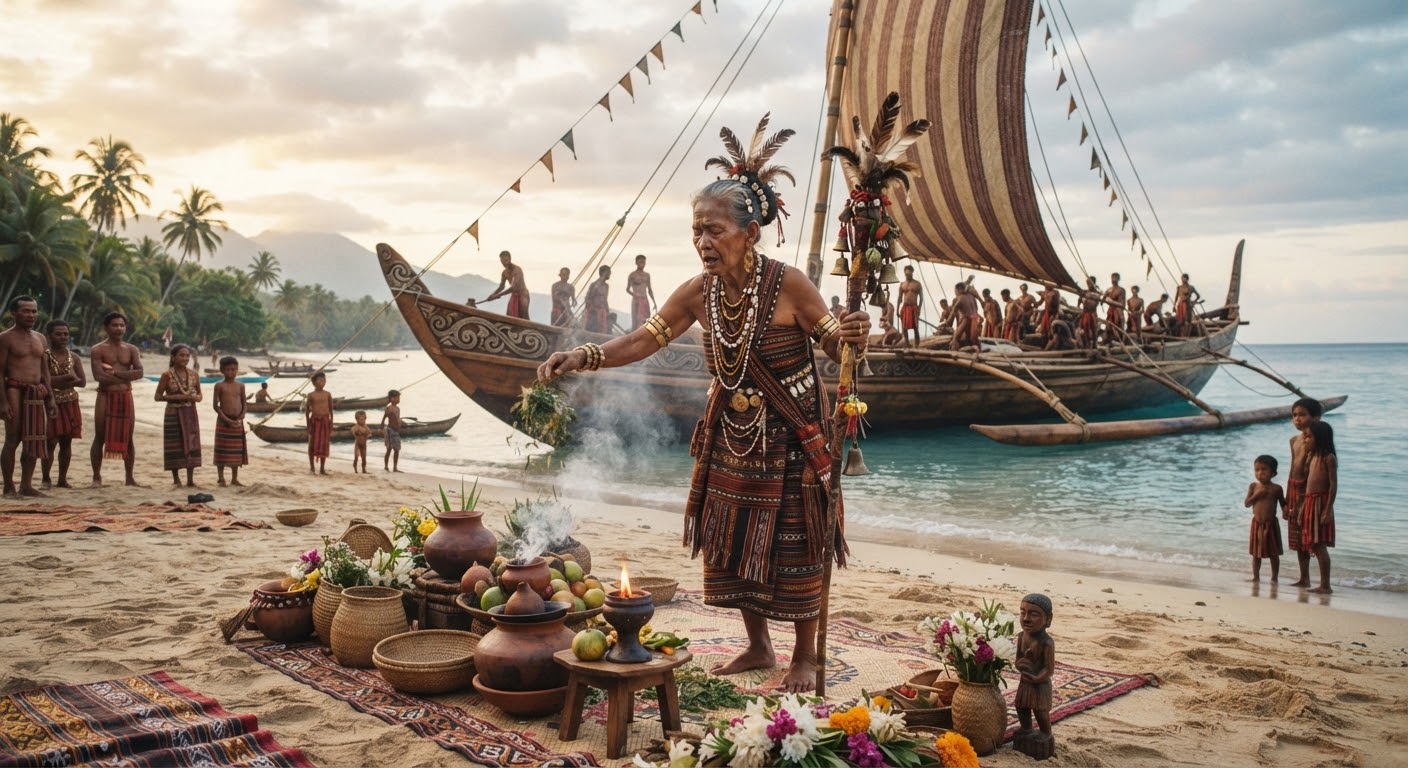
Raiding was not simply a military action. It was often surrounded by ritual. Before an expedition, leaders might perform ceremonies to seek protection, ensure success, and maintain spiritual balance. These rituals show that warfare was not separated from belief. It was embedded in a broader worldview in which the spiritual and material worlds were deeply connected.
One of the most striking symbols of raiding culture was tattooing. In Spanish accounts, Visayan warriors were called los pintados, or “the painted ones,” because of the elaborate tattoos that covered their bodies. These tattoos were not decoration alone. They recorded achievements, bravery, and experience. Each mark could signify a battle fought, an enemy defeated, or a deed of honor.
For warriors, tattoos served as a visible record of status. A body covered in ink showed that a man had participated in raids and proven himself in combat. In that sense, the skin became a historical document. It told the story of a life lived according to the values of the warrior class.
Economic and Social Functions
Although violence was central to pangangayaw, the practice also had economic and social functions. Captives taken during raids could be used as labor or incorporated into households. Goods seized from rival communities could increase a datu’s wealth and help him reward followers. Raiding therefore contributed to redistribution within a society that depended on the ability of leaders to attract and maintain support.
It also shaped relations between communities. Raids could weaken rivals, intimidate opponents, and disrupt trade networks. At the same time, the possibility of retaliation meant that raiding existed within a cycle of conflict and negotiation. It was part of a system of competition in which power was always being tested.
Historians such as Laura Lee Junker have described this world as one of “raiding, trading, and feasting.” These were not separate spheres of life but interconnected strategies for building political authority. A successful chief had to be able to trade goods, host feasts, and lead raids. Each activity reinforced the others.
“Raiding, trading, and feasting were not separate spheres of life but interconnected strategies for building political authority.”
Colonial Conflict and Reinterpretation
When the Spanish arrived in the 16th century, they encountered societies already shaped by maritime warfare. Over time, the colonial government tried to suppress indigenous raiding in the lowlands, where conversion to Christianity and Spanish rule altered local power structures. But in the southern Philippines, especially among Muslim polities such as Sulu and Maguindanao, raiding traditions continued and evolved.
Spanish chroniclers often labeled these maritime warriors as pirates or enemies of order. But that label reflected colonial interests more than historical reality. From the perspective of many southern communities, raiding remained a legitimate and even necessary practice. It was tied to trade, diplomacy, and regional politics, not merely criminal violence.
The long conflict between Spanish forces and Moro polities lasted for centuries and deeply affected Philippine history. Forts were built, coastal communities were militarized, and sea lanes became sites of recurring struggle. The colonial record often obscured the original meaning of pangangayaw, reducing it to piracy. Yet the tradition must be understood in its own social and historical context.
Legacy
Today, the age of karakoa and raiding fleets is gone, but its memory survives in historical records, museum artifacts, oral traditions, and scholarly research. Tattoos, weapons, and boat traditions remain powerful symbols of a maritime past in which Filipinos were active participants in a wider Southeast Asian world.
Pangangayaw reminds us that pre-colonial Filipinos were not passive island dwellers waiting to be “discovered.” They were navigators, traders, warriors, and political actors in a sea-centered civilization. Their world was dynamic, competitive, and deeply connected to the rhythms of the ocean.
Understanding this tradition gives us a fuller picture of Philippine history. It shows that power was once measured in boats, bravery, and alliances. It also reveals how colonial labels can distort indigenous practices. To study pangangayaw is to recover a part of the past that was long misunderstood, but never truly lost.